Showing posts with label Traditions-of-ASIA. Show all posts

Saturday, February 21, 2015

Fair in Pushkar


Thousands of trader’s camels walked along a small Indian town, participating in a weeklong festival of sale and exchange of animals.


Traditional fair is held annually in the city of Pushkar is one of the largest marketplaces to buy or exchange camels.


The festival, which begins today, will have to bring together about 20 thousand camels, which is now the site of action are shepherds. Horses and cattle will also attend the fair, which, according to the organizers, attracts more than 200,000 visitors from all over the world.


In a series of everyday city Pushkar - a place of pilgrimage, but only comes Kartik Purnima festival (full moon day), the usual Indian city turns into a festival of colors and entertainment. By Reva camels hundreds or even thousands of Hindus go on recruiting bathing in the sacred waters of local lakes, to atone for their sins. Two for polnulya have a vision the people of India are the most favorable and most prone to those who redeemed at this time in the holy water of the lakes.


By the way, fair in Pushkar includes not only traditional trading camels, but also many other interesting activities, namely distillation and even camel camel beauty contests, as ironic as it may sound. And where do without Indian meryanie mustache, which take place at the fair and animals.


Sankei-en Garden

Sankei-en Garden Colorful Familiarity with Centenary History (Japan)


The most comfortable and quiet place in Yokohama considered Sankei-en Garden, which is about one hundred and eighty square kilometers. For the fact that today everyone can enjoy not one of historic buildings located in the garden, you should thank the wealthy merchant Sankei Hara - the creator of this wonderful place.


Beautiful landscaped park, a monument of Japanese culture has long celebrated its centenary. Despite his advanced age, he continues to amaze clean ponds, beautiful trails and a variety of colors.


In late summer, the park fills amazing fragrance blooming lotus, from which it is simply impossible to look away.


Never goes unnoticed by visitors Sankei-en Garden and the old three-tiered pagoda, who settled in this area in the XVI century. Seeing this ancient structure, be sure to have a desire to rise to her steep steps carved into the earth.


In addition to the pagoda in the park you can see a lot of interesting buildings, among which it is worth noting medieval farmhouse - silent narrator of the life of ordinary people, a tea house Tesyukaku, villa Tokugawa Rinsyunkaku - famous shogun.


Sankei-en Park is beautiful any time of year: winter, tourists can admire not only the beautiful snow white and powdered, and plum blossoms, spring - cherry blossoms and azaleas in the summer - beautiful irises, but the autumn - colorful chrysanthemums and Japanese maples, which at this time blaze a variety of colors.


Festival of Hindus

Rath Yatra Sacred Festival of Hindus(India)


Wooden sculpture Jagannath, who is one of the incarnations of Krishna, as well as the protagonist Ratha Yatra is fraught with mysterious sacred object. According to the legends of the Hindus, the object is the remains of Krishna.


Wooden sculpture, staying in a humid climate, and subjected to the negative impact created by the environment, gradually deteriorates. For this reason, once a decade, made a new wooden sculpture, which is transferred and mysterious object.


The person performing the rite of transfer of the remains of the so-called Krishna, to be blindfolded and his hands are wrapped with a cloth. Indians noticed that the perpetrator of this rite lives after not more than a year, so this honorable mission given to the priests, who crossed the line of ninety.


During the Ratha Yatra sculpture Jagannath carried out of the cathedral, setting it on a giant chariot to make a trip to the temple, located in the neighborhood. In order to bring a huge chariot in motion requires a lot of effort, so it moves the whole crowd of people.


The population of a small Indian town of Puri, where about two hundred thousand people during the holiday increases up to a million.


During the solemn procession each of Hindus seeking to touch the sacred wagon, because this action is equivalent to commit several good deeds. Not surprisingly, that has created an incredible jam where to get under the chariot everyone can. The opportunity to die in the crush is not very much and scare the Indians, because these dead expects Vaikuntha, which guarantees eternal bliss. People pulling the chariot over the ropes, to forgive sins for the whole year.


Chinese New Year

Chinese New Year Spring Festival


To the most important and lasting holiday - New Year in China very seriously. Signal the beginning of the celebration are bright and colorful fireworks, which the Chinese have high expectations, because they are attracted to the house of happiness and peace, breaking up before all the evil spirits. After the 1911 New Year's literally called the Spring Festival (Chunjie).


Cast in the New Year's Eve all evil with the help of strong noise and crackling in China began in the XIV century, as well as fireworks and firecrackers was not there, people were thrown into the oven bamboo sticks that during combustion published loud crackling.


In the land of the rising sun firmly believe in the same way that you can scare away evil spirits with a red color, so the New Year in every home it's hard not to notice the predominance of red tones, even the money that give children on holiday, try handing in red envelopes.


Traditionally, the holiday’s door lintel decorated with five long strips of paper that have to bring to the house of longevity, happiness, luck, wealth and honor.


Chinese New Year's Eve is considered the most important moment of the year, so for them it is very important to gather at the festive table with the whole family. Among the huge abundance of holiday treats will certainly be present dishes from tofu, chicken and, of course, fish.


The first five days of the New Year, or Spring Festival, as it is like to call in China, people visit relatives, friends, co-workers, while giving those gifts. Linger at home, as a rule, these days no one wants, because the streets are constantly held fun fairs, noisy festivities, where you can dance in the costume of a dragon or participate in the rooms on stilts.


Completion Merry Christmas festivities, which last fifteen days, comes after the Lantern Festival.


The history of this festival, which is informally also called "lunar new year" has for many centuries. It does not have the exact date, because it is calculated from the Far East lunar-solar calendar (about this may be one of the days during the period from 21 January to 21 February).


Chinese New Year - it is a manifestation of great respect for the traditions, myths and beliefs.


Friday, February 20, 2015

Festival rolls into Chhenchau

Festival Rolls into Chhenchau (China)


The small island of Hong Kong is famous for its Chhenchau annual festival rolls, which is traditionally held in late April or early May. These days, thousands of tourists come here, to take part in a fascinating "hunt for scones."


The festival has a preliminary stage, where during the various events are selected twelve candidates who will fight later in the main program. It takes about two weeks before the festival. A few days before the opening on the skeleton almost every day there are a variety of shows and performances.


When it opens the festival, a grand parade is held, during which visitors can see the famous Chinese dancing lions and tigers, as well as dancing children dressed in traditional costumes. The parade was attended by many teams, representing various organizations, each of them has its own number. During the procession necessarily revered god Pak Tai, which is considered the protector of the island.


On the same day, late in the evening match occurs, which marks this festival, the so-called climbing the mountain of buns, which occurs in two stages. First compete twelve people who have won a preliminary stage, passing two weeks before the festival. Each of them must, climbing on plastic buns on the mount, remove as much of the top trophies in his bag for three minutes.


Thus, the higher the brioche is placed, the more it has balls. At the top are nine-bun, a little lower - a three-point, and at the bottom. The winner is the party in whose bag will buns with a large number of points.


In the second stage the team compete with each other, having in its composition of three. Their main goal remains the same as in the individual program - to collect buns, which would have the greatest number of points.


After the exciting races are traditionally awarded to the winners, with the closing of the festival is also held in a festive atmosphere where a lot of music, performances and fireworks.


Sunday, February 15, 2015

Jade Burial Suits Immortality

Jade Burial Suits Immortality yesterday with Gold Thread

(China)

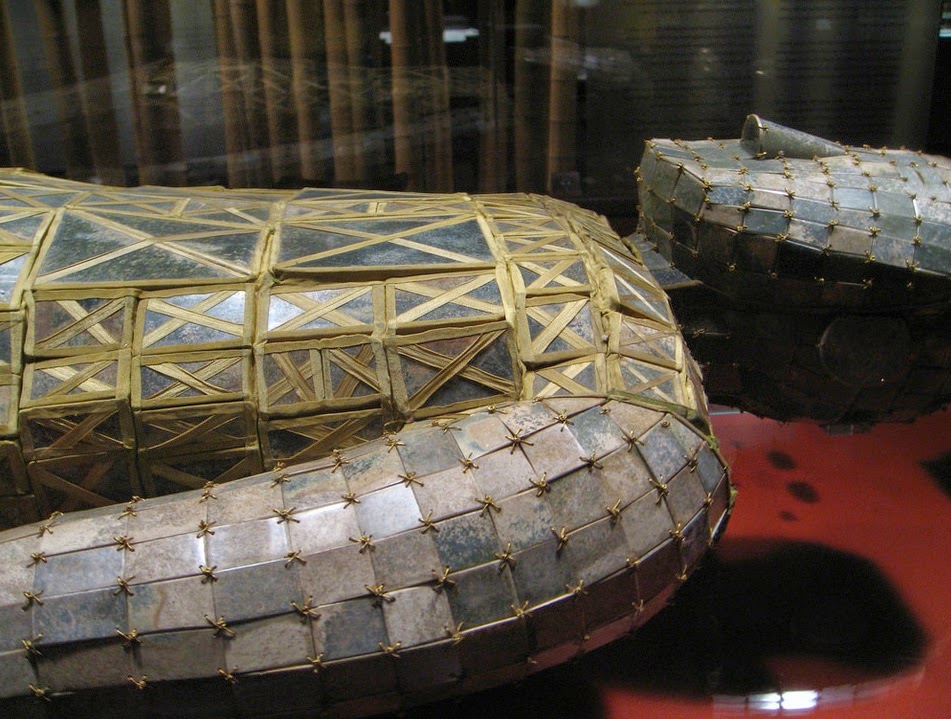
Jade burial suit - it is the collective name of the archaeological finds from China, which are themselves linked with gold and silver burial suits. They were used as a protection for the afterlife, preventing the decomposition of the body of the owner.
The first documentary evidence of jade suits date back to 320 BC, although archaeologists say they have appeared for half a millennium before. For the first time jade garments were investigated in 1968 after excavation grave of Prince Liu Sheng and his wife Princess Dou Wan. One of the most important archaeological finds of the XX century - the untouched tomb of the rulers of the Han Dynasty was unearthed in Hebei Province.
Each of the green funeral costume consists of two thousand jade tiles. While the princess costume is sewn with silver thread, armor Prince Liu Shen sparkling gold metal. All were found about twenty jade suits: so rare due to their high cost and complexity of manufacture. Even the most skillful smith had to work on the creation of a suit at least 10 years. In 223 BC Emperor Wen ordered to stop production of jade suits, as many thieves ripped and burned the tomb of costumes to get the golden thread.
The Chinese believed that jade is not only able to prevent the decomposition of soft tissues, but also wards off evil spirits. Who is the mysterious costumes are stored in the Museum of Hebei Province.